

you are everywhere
sit a spell: volume three

I’m back with another edition of my bench plaque column, where I write about bench plaques I saw on a particular day and the journey I took getting there. Today, I’m going back to a day from the spring of this year.
On May 26 I adventured up to Central Park to sunbathe with my friends. I had bleached my eyebrows to oblivion and the humidity was making my hair curl. I was feeling lost, my career had ended up in a place that felt totally wrong. It had almost felt like I had already settled in a job that was the wrong fit and I had given up without even noticing it. I wanted to try again, but was too exhausted to get up and do it.
The trees were a blazing green and the sun felt all-consuming. My face was being caressed by the sun and it felt like maybe I could have another chance to try again.
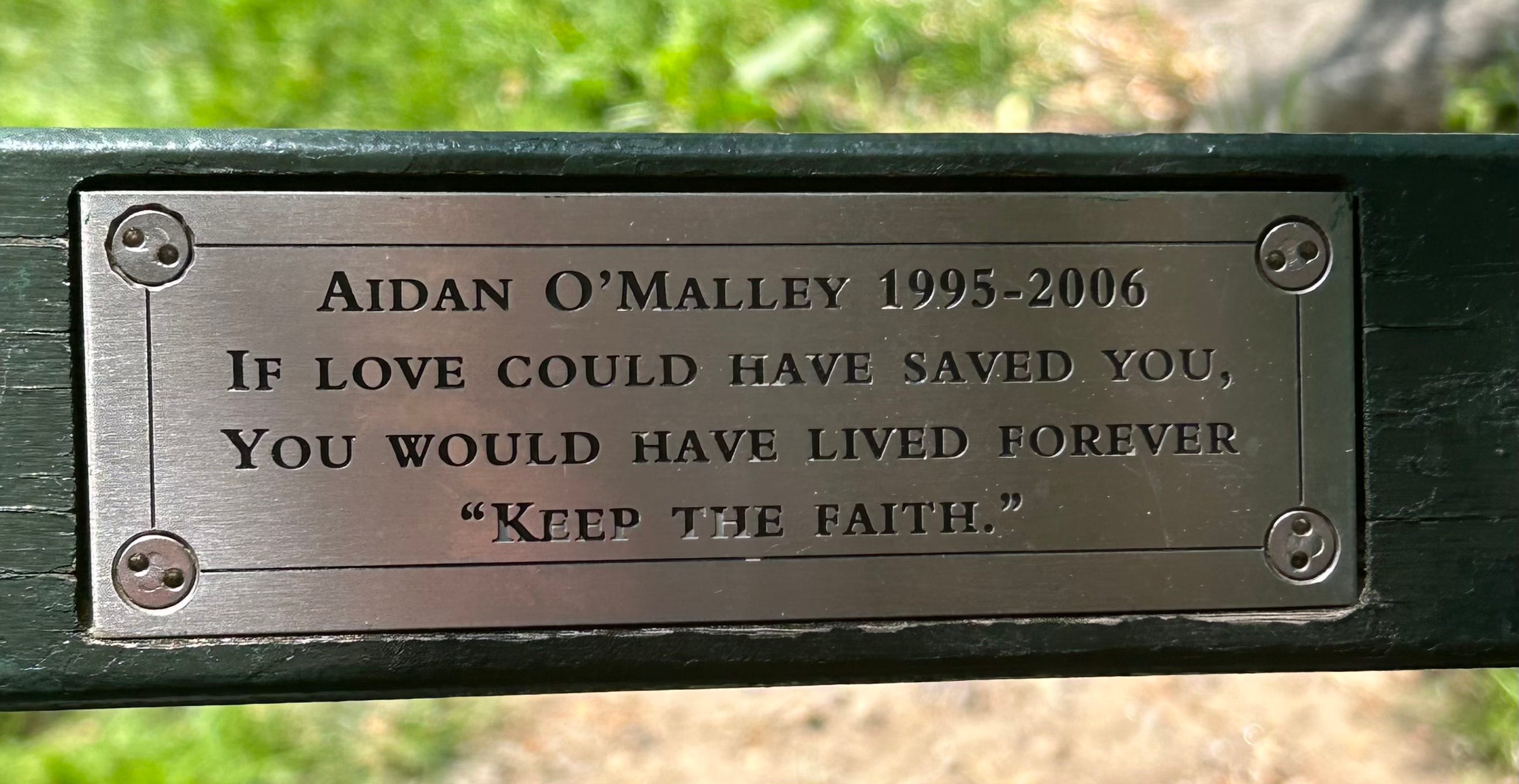
On my way up I found a memorial plaque for an 11 year old boy that read, “If love could have saved you, you would have lived forever.”
I often find myself thinking that losing someone to suicide is significantly different than losing someone any other way. It might be a self aggrandizing belief, but it feels like a loss that alienates you from everyone else’s loss. It is a way of losing someone that everyone seems to find deeply uncomfortable.
Reading this plaque made me reflect on my own selfishness, my own wallowing. I don’t know the parents who paid for this plaque, or how their son died, but I knew what it was like to be them.
A year ago, while doing a project for work, I had stumbled on a charity called “To Write Love on Her Arms.” It is a nonprofit organization that seeks to provide resources for people struggling with depression and suicidal ideation. They sold t-shirts that said “Love is the movement.”
At the time, this charity fueled me with ire. I hated its name, its t-shirts, its slogans. This message that love will help prevent suicide infuriated me. It’s a common sentiment you see in suicide activism, and I find it hollow and sanitized. I wish that preventing suicide was as simple as checking in on friends and telling people you love them, it would have made my life significantly easier if so.
Now, I’m sure this charity has done a lot of good for people and helped people, especially teens, struggling with self harm. But, I really struggle with any moralism about love being a solution. I loved my brother and so did many other people. He had a solid group of friends, lots of family members who made an effort to help him. None of these things made a difference. No one wants to hear it, but there are many times where love is not enough. Where love doesn’t even factor in.
I have never done suicide activism and I don’t think I ever will, because my outlook on suicide prevention is not that positive. If someone truly wants to die, they will find a way. A lot of times, it is completely out of your control.
I took this charity’s message personally. Do you not think I loved my brother enough? Do you not think that I tried?
I don’t have this level of animosity anymore, but my opinions on suicide remain. It is a complex issue involving brain chemistry that there is no simple solution for. I had to accept that there was nothing I could have done for my brother. He would have died anyway. It’s not any easier to live with than the guilt.
I think of this bench plaque often. If love could have saved my brother he would have lived forever.
I also came upon two matching bench plaques for a couple that both died in their 60s, eleven years apart.


These were a fan favorite in my viral bench plaque thread, and they are a personal favorite of mine as well. How nice it is to be able to be next to someone, forever. I think these encapsulate what it is I love so much about bench plaques; a glimpse into someone else’s love through the form of a physical object that will outlive you, and everyone you know.
In “The Banshees of Inisherin,” two best friends fued over that lasts, art or niceness. Colm, played by Brendan Gleeson, is struggling with his feeling of being unfulfilled and his fear that he has failed to do anything memorable. He cuts off his friendship with Padraic, played by Colin Farrell, to devote himseld to making music, the thing he believes actually matters.
Padraic is hurt, he believes that kindness matters, even if it doesn’t last forever.
“My mammy, she was nice. I remember her. And my daddy, he was nice. I remember him. And my sister, she’s nice. I’ll remember her. Forever I’ll remember her,” he tells Colm.
Even when everyone who knew Linda and Steven is gone, this bench plaque will remain. People will read it and think about them. In a way, the love lasts forever.
The last bench plaque from this day that really sticks with me is a memorial plaque for Gwyneth Paltrow’s father. It reads, “Now that you are gone, you are everywhere.”
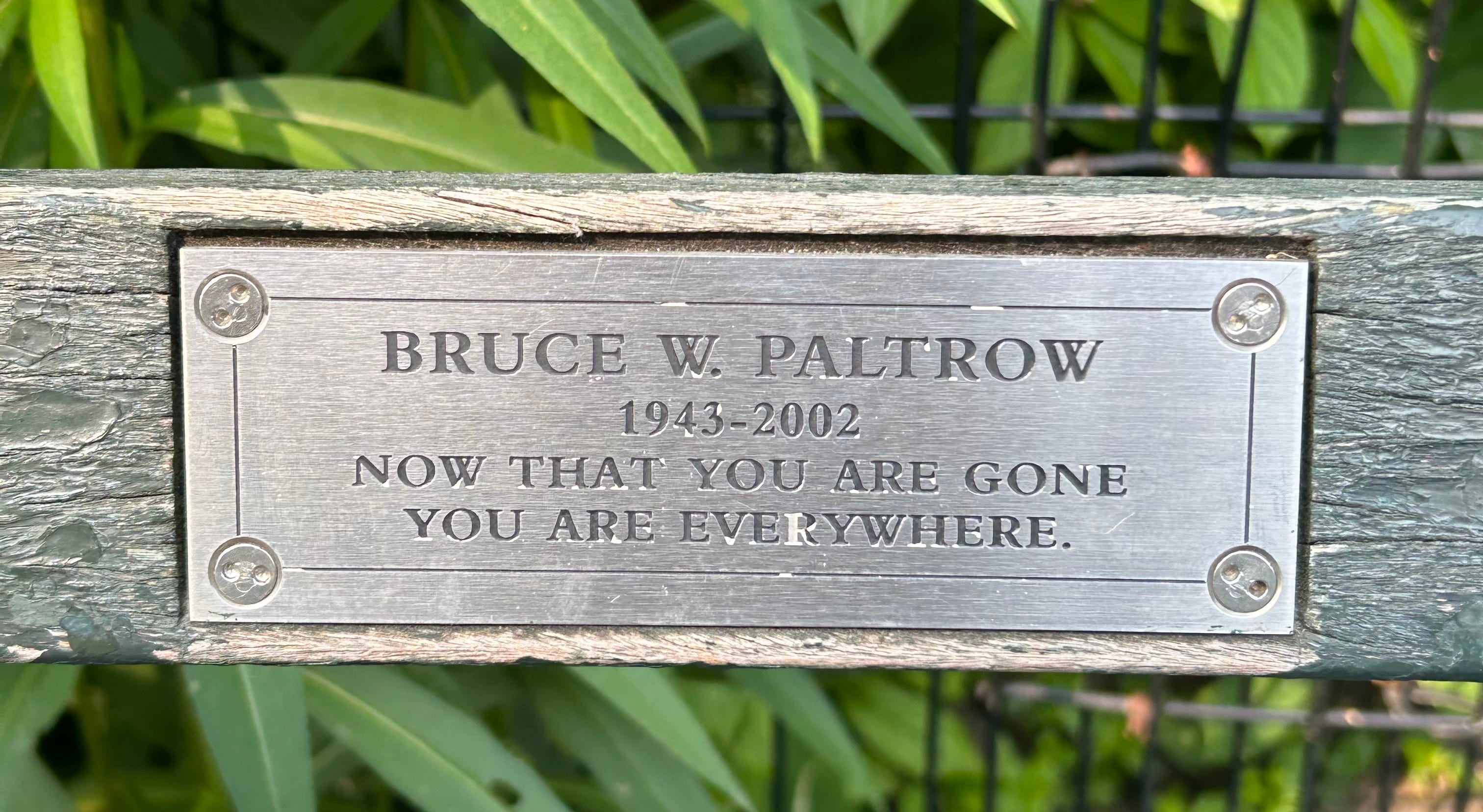
After he died, my brother came back to me in the form of a hummingbird and a black squirrel. He also haunted my laptop for months. I still see him everywhere, in everything.
In Sufjan Stevens’ song 'The Only Thing',’ he sings “Everything I see returns to you, somehow…everything i feel returns to you, somehow.”
I often find comfort in how media about grief can feel real to a multitude of people. Grief makes you feel alienated in your own suffering, and it is nice to be reminded how common your feelings truly are.
After my friends headed to other activities after sunbathing, I decided to stick around the park and read for a little bit. I found a shaded portion of the park less crowded with people who seemed happier than me.
I was finishing up an Alice Munro short story collection. Sitting on a bench in the shade, watching the reflection of the trees dance across the pages, made me want to try again.
Beautiful Rory. Thank you for sharing. Hugs